
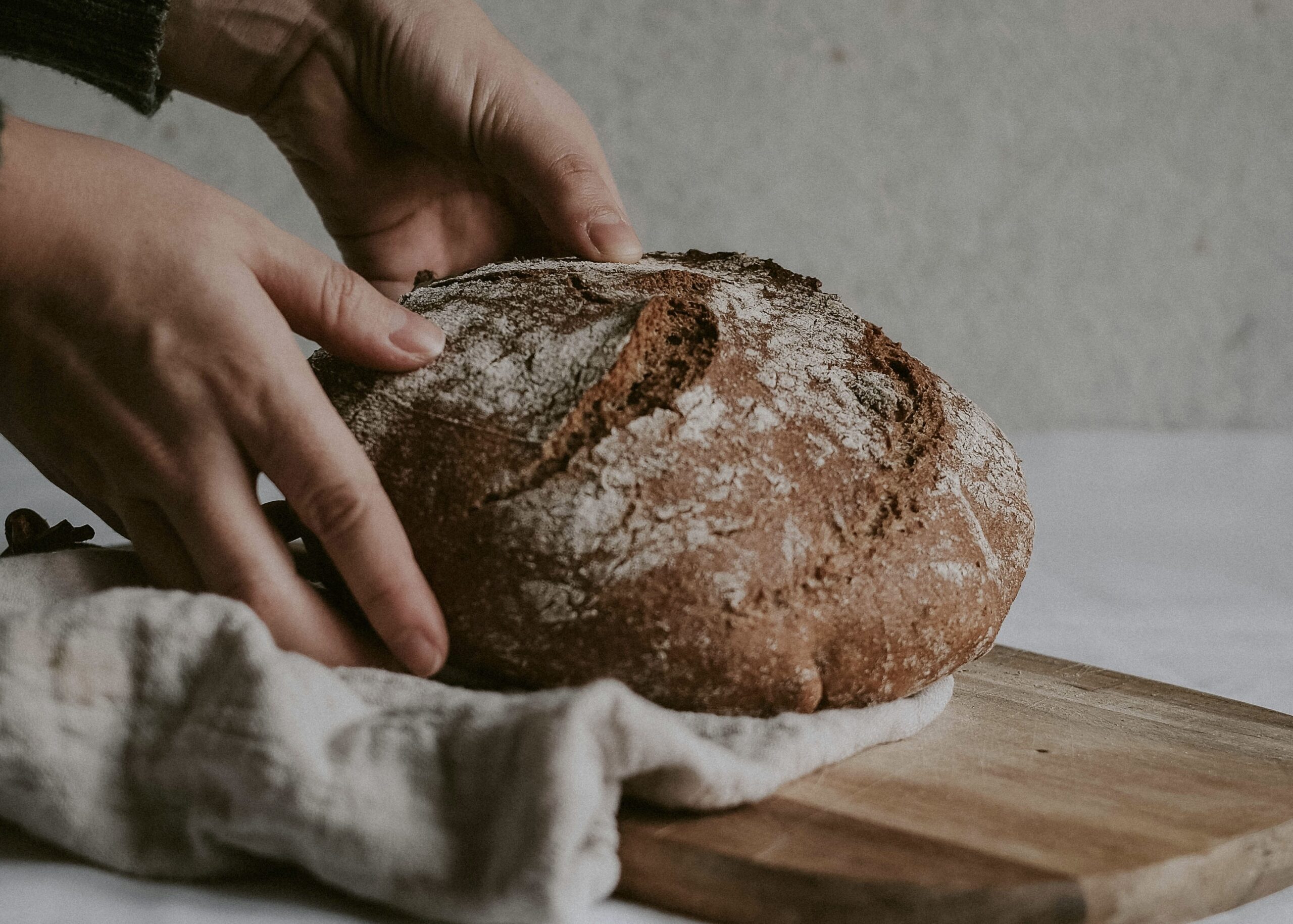
Food is Tangible Love
As November pulls into full view, food becomes both a topic of discussion and a source of stress. For me, food was also a big part of home, and how I felt loved. When my puppy died, I still remember how Mom made for supper my favorite tuna salad, with no boiled eggs (though everyone else loved the eggs). Mom knew I needed to eat, but more than that, I needed to know I was surrounded by love. I now see how so much of Mom’s life and ministry involved food.
Turns out, it isn’t just with my mom. Throughout history, God has used food and nourishment to demonstrate His loyal love and patient care.
FOOD IN THE BIBLE
It’ s no coincidence that love is the very essence of God (1 John 4:8 and 4:16) , and that Jesus calls Himself the Bread of Life (John 6:35).
Food is found throughout Scripture. Jesus bookended His earthly ministry by transforming water into wine at a wedding feast in Cana (John 2:1-11), concluding His time on earth with the Last Supper (Luke 22:14-20). He fed a multitude with five loaves and four fishes (John 6:1-14), ate with sinners and tax collectors (Mark 2:15), and was anointed with oil and a woman’s tears during a meal (Luke 7:36-50). He used parables about wedding feasts to teach humility and hospitality (Luke 14:7-24). He fed the disciples after a long night of fishing by inviting them to dine (John 21:8-14). When He encountered two disciples on the road to Emmaus, they didn’t recognize the resurrected Jesus until He later broke bread with them (Luke 24:30-35).
By food in the garden man first expressed his disobedience, and by food at the Lord’s table, we express our obedience.
To trace love through Scripture, you need only follow the food.
Indeed, to trace love through Scripture, you need only follow the food.
A MINISTRY OF LOVE
A shared meal is the activity most closely tied to the reality of God’s kingdom.”
– Christine Pohl
As we raised our family, my husband and I took the prevailing advice, and made family dinner a priority. The table was a sacred place. It came naturally, because “the table” in my own childhood home had a special protection. Certain words, all toys, and any impolite behavior were banned. But it was what was included there that made it special.
Not sure if it was because she was a little girl growing up on the heels of the Great Depression, or a young wife figuring out the finances of midcentury farming, but Mom was always loving her people best with food.
Mom not only made marvelous from-scratch meals, but also the most stunning birthday cakes: Cinderella’s carriage, a farm, a carousel. But it wasn’t always just about the presentation. She carefully packed Dad’s sweet iced tea for the field in a frozen mason jar inside an empty sugar bag for insulation.
Mom was famous on my high school debate team for the food she prepared for the tournament judges. And no church dinner could happen without her contribution all my growing up years. My friends wanted to spend the night just to eat Mom’s homemade delights.
Even at age 84, Mom had at least half a dozen freezers – always full of her pies and crescent rolls and casseroles. So much more than even her extended family could consume. I never saw her preparing it—the food seemed to just appear. As the last freezer was removed from their garage in settling their estate, I sighed in relief. But a sadness and realization came flooding in that afternoon.
Moms’ freezers had fed not only her community, but also her far-away family. We never left her house empty-handed: cookies or brisket, cinnamon rolls or bierocks. And as a final act of love, her overflowing freezers fed us every trip back from her death until we walked out of that house for the very last time before handing the keys to the new owners.
And we thought we were there to wrap up her affairs.
Mom used what she had, and served a lifelong ministry she never formally signed up for. She did it because it’s what she could do, she knew it mattered to people, it’s a universal language, and it brings comfort.
ON THE WORST DAYS
It had to be one of Jesus’s worst days. His close cousin had just been beheaded by Herod. And yet, it was Jesus who served. He fed multitudes just after John the Baptist’s murder: a way of healing, honoring, moving on. Jesus showed us that a way to handle deep grief is in serving. (Matthew 14: 13-21).
Meals are such a fond way to remember a friend…sharing life is the first way we live into legacy, and…gathering nourishment is a way that we pass on peace.
Like Jesus in His loss, Mom often met needs not out of her abundance or best days, but from her worst. At her lowest point, Mom knew the best way out is to reach out. I remember her sending roadrunner bars to a neighbor’s grieving family just a week after Dad’s funeral.
At her lowest point, Mom knew the best way out is to reach out.
The only miracle, aside from the resurrection, recorded in all four gospels is this feeding of the 5,000 from one boy’s five loaves and two fish. The Spirit wanted to make sure we didn’t miss it.
A TRANSIENT BEAUTY
Fall colors are stunning in Northwest Arkansas, but they won’t last long. They are a blessing that doesn’t stay.
From my journal:
Here I am again on the Ongoing Prayer List, after I thought my name had been permanently erased. I suppose there was truth to the “chronic” part of my diagnosis. But it seems any healing here is only for a season, and mine, apparently, has passed.
Indeed, the ministry of food matters most when someone is in a place they don’t want to be: the hospital, the funeral home, the divorce court, the prayer list. Even when that stay is temporary.
Mom’s meals were a feast—and remembering how my dad ate—often a fast one. It’s why I’ve shied away from making big meals for years: They take so long to prepare, and they are over so quickly.
Like our autumn leaves, the beauty in Mom’s meals were in their impermanence. And in how they, even temporarily, brought us all together.
Though her food was transient, Mom’s love was not. I see her so often in the grandchildren she adored, and the great grandchildren she never got to meet. As I watch my oldest child nurse her newborn son, cater to her finicky toddler’s meal requests, then effortlessly make my own mother’s recipe of homemade egg noodles, I am reminded that food is the language (and legacy) of love.
It’s why we instinctively take food to sick and grieving people. It’s not their most important or most deeply felt need, perhaps, but while other mundane tasks can be ignored or delayed, often food cannot.
We don’t live by bread alone, but we also don’t live long without it. To eat is to acknowledge our dependence both on food and on each other. It also reminds us of other kinds of emptiness that not even the blue-plate special can touch.
– Frederick Buechner
OUR DEEPEST HUNGER
Jesus chose not to permanently quell the crowd’s hunger pangs. The 5000 would soon feel hungry again. He was showing us that as long as the food is not the point, it’s not the end of the relationship.
The first meal for my husband was not a success, at least not in the eyes of the receiver, who was not impressed with my thrifty idea to swap ricotta for cottage cheese in my newlywed attempt at lasagna.
But that was not the end of the relationship, as that same recipient became the giver of my first meal as a mother – the contraband of a cheeseburger and fries in a bag I recognized, appearing on my hospital tray so quicky after I made it to my post-delivery hospital room.
In both instances, the point was love. Just as in the Bible, food is never just physical sustenance.
Reading all of Scripture reminds us that God cares for a single child as carefully as He does a crowd:
All at once an angel touched him (Elijah) and said, ‘Get up and eat.’ He looked around, and there by his head was some bread baked over hot coals, and a jar of water. He ate and drank and then lay down again. The angel of the Lord came back a second time and touched him and said, ‘Get up and eat, for the journey is too much for you.’ So he got up and ate and drank.
1 Kings 19:5-8
Fleeing Jezebel on one of Elijah’s most desperate days, God didn’t rebuke him. He didn’t quote Scripture at him or tell him to “Choose Joy.” God didn’t tell him how much worse it could be. And God didn’t tell him that He will never give him more than he can handle. There was no bootstrapping, guilt-tripping, or gas-lighting. Instead, God touched him. And fed him—twice. A tangible measure of comfort: bread hot out of the oven. (If Mom had been involved, a tuna salad with no boiled eggs. Likely a pan of roadrunner bars.)
It was so much a part of her, I’m not even sure Mom realized she was saving us. And maybe that’s the point. She wasn’t doing it to be labeled a rescuer. Or even a sustainer. She did it out of love.
God is motivated by love, too. He sees and responds to both our extraordinary and our ordinary needs. In fact, I believe Jesus satisfied physical hunger so we could see that He alone is capable of satisfying our spiritual hunger.
Perhaps food was always meant to be just a tether, keeping us close to the truth that we are not our own sustainers. What if our next hunger pang is more a reminder of our need for Him than it is a reminder to eat?
Perhaps food was always meant to be just a tether, keeping us close to the truth that we are not our own sustainers.
Just as Jesus’ miracles were never about the miracle itself, Mom’s fixation on food was more a lesson and a legacy.
The boy with five loaves and two fishes shows us this: God knows what’s in our hands isn’t enough to change the world or even our little reality on its own. But His touch changes everything. He’s just waiting for us to grab something to share—perhaps a pan of roadrunner bars from the freezer—and join Him.
Listen to this post read by the author HERE.
Thank you for this. I have never looked in the Word to see how often food, or a meal, was a ministry of love.
I have never heard of roadrunner bars. Would you share the recipe if you still have it?
Blessings,
Teresa
Great to hear from you, Teresa! Thanks for asking about Mom’s recipe. Yes, I’m working on the best way to share it. Look for more information in the November newsletter coming to subscribers November 18. Have a wonderful week!
Gosh, you brought back a lot of wonderful memories, Lori! And tied it so beautifully into faith and the Scriptures. What a beautiful reflection! Makes me hunger for many things!
Brad, what a blessing it is to have siblings who share my memories. Great to hear from you!